Explainer · Data Platforms
Mobility as a service: what actually stuck
Mobility as a service promised one app to plan, book, and pay for every trip on a subscription. The flagship consumer bundle went bankrupt. Here is what the idea got right, what it got wrong, and which pieces survived.
Mobility as a service, or MaaS, is the idea that a rider should be able to plan, book, and pay for any trip across any mode from a single app, ideally on a subscription, the way you buy a phone plan. For most of the past decade it was the most-hyped idea in urban mobility. The reality check is now in. The flagship consumer version of that idea, a private app that bundled every mode on a monthly subscription, did not hold up as a business. Its best-known example, Helsinki’s Whim, stopped operating and its parent company filed for bankruptcy in 2024. What survived was quieter and more useful: the plumbing. Open transit data, multimodal journey planners, and integrated ticketing all stuck. The single super-app that was supposed to own the customer relationship did not.
That gap between the promise and the outcome is worth sitting with, because MaaS was never one thing. The term stretched to cover a phone app that shows you bus times and an all-in-one subscription that replaces car ownership, and those are not the same product or the same bet. Sorting out which part of MaaS worked means being precise about what kind of integration you are actually talking about.
What MaaS actually means
The most useful way to be precise comes from a 2018 paper by Jana Sochor and colleagues at Chalmers, which proposed a topology of MaaS built on levels of integration. Instead of arguing about whether something counts as “real” MaaS, the model asks how deeply the separate mobility services are stitched together. It has five levels, from none to full.
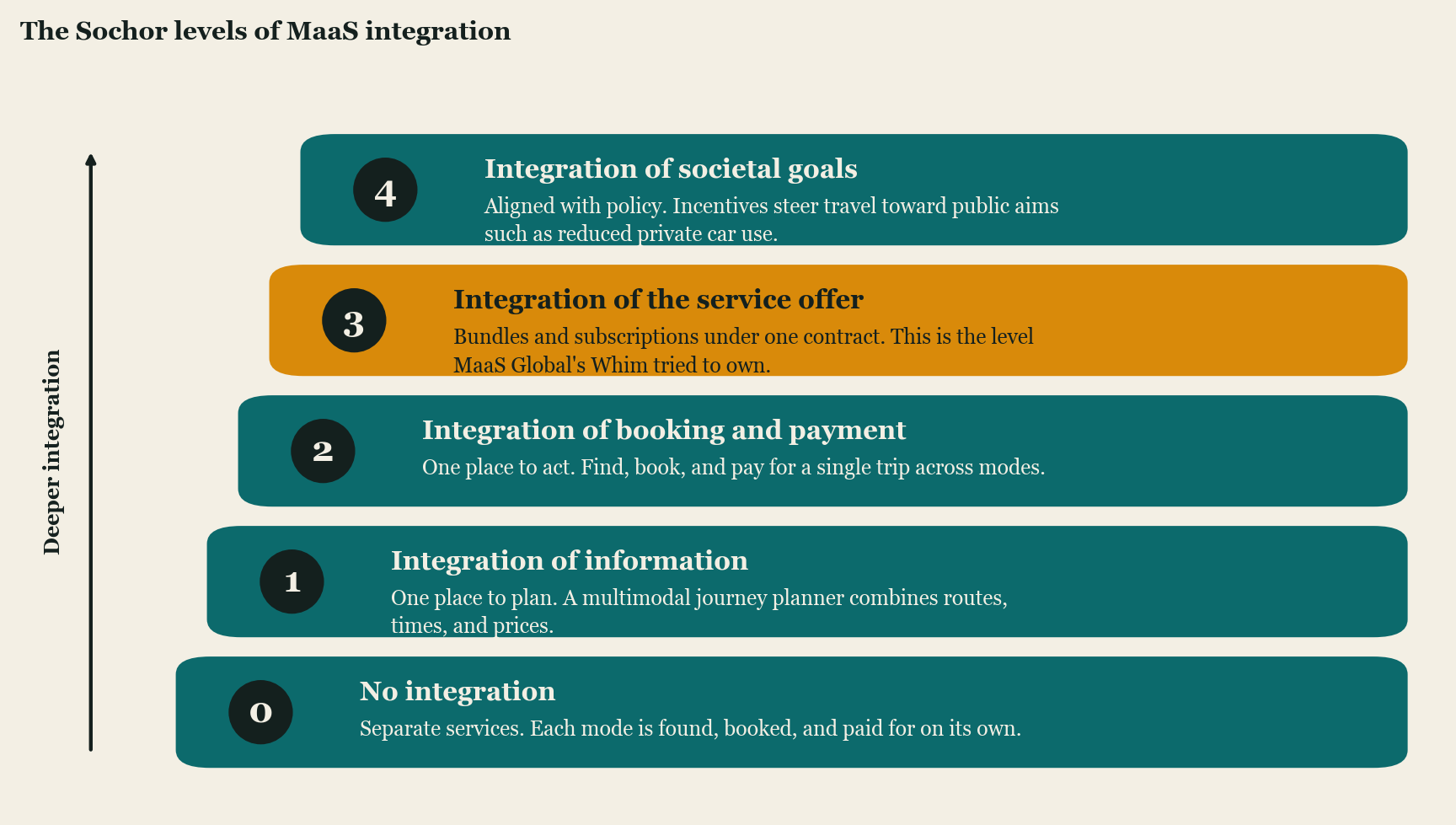
The distinction the ladder makes clear is that the lower rungs and the upper rungs are different kinds of work. Level 1 and Level 2, information and payment, are largely a data-and-software problem: given open feeds and a payment rail, one app can combine routes and sell a ticket across operators. Level 3 is a business problem. Bundling modes under one contract means an aggregator has to buy capacity from taxis, transit, bikes, and car-share, resell it as a package, and carry the risk when a subscriber uses more or less than they paid for. Level 4, aligning the whole thing with public goals such as lower car use, is a policy problem that almost no deployment has reached in practice. The hype treated all four as one continuous roadmap. The failures clustered at Level 3.
The Helsinki experiment
No company embodied the Level 3 bet more than MaaS Global, the Finnish firm behind Whim and the outfit that did more than anyone to popularize the term. Founded in 2015, it raised a 29.5 million euro round in 2019 from backers including Toyota, BP, and Mitsubishi, on top of earlier funding. Whim launched in Helsinki and expanded to Turku, Vienna, Antwerp, Birmingham, Tokyo, and across Switzerland. The pitch was clean: one subscription covering public transport, taxis, rental cars, bikes, and scooters, priced to make giving up a private car feel easy.
The economics never caught up with the pitch. By its own filings the company had around 10,000 active users in Helsinki and lost 9.3 million euros in 2022 on revenue of 3.8 million euros. Reselling other operators’ trips at a subscription price left thin or negative margin on each ride, and the fixed cost of running the platform and the local business agreements did not shrink with it. In early 2024 the company told customers the Whim app would stop operating, and weeks later it filed for bankruptcy in Helsinki. Its assets were bought out of insolvency, but the flagship consumer subscription was done.
It would be easy to read that as a single company’s mismanagement. The more useful reading is that Whim was the clearest test of the Level 3 consumer bundle, and the test came back negative for reasons that ran deeper than any one company’s execution.
What the pilots showed
Whim was not the only attempt, and the earlier evidence was genuinely encouraging, which is part of why the idea was funded so heavily. The record splits by who ran the service and what they were trying to prove.
| Initiative | Where and when | Model | What it showed |
|---|---|---|---|
| UbiGo (Go:smart) | Gothenburg, 2013 to 2014 | Research field trial, prepaid monthly bundle | About 195 participants shifted away from private cars toward transit and shared modes and were satisfied. Behavior change was real at small scale. |
| Whim (MaaS Global) | Helsinki and six other markets, closed 2024 | Commercial Level 3 subscription super-app | Roughly 10,000 active users in Helsinki, heavy annual losses, bankruptcy in 2024. The commercial bundle did not pencil out. |
| Jelbi (BVG) | Berlin, still operating | Public-operator-run integration app | Integration owned by the transit authority rather than a private aggregator. |
The UbiGo field trial in Gothenburg is the study most often cited as proof the concept could change behavior. Over about six months, participants who bought a prepaid bundle of transit, car-share, taxi, and bike trips did drive their own cars less and use public transport more. Sochor’s team called the appeal a “transportation smorgasbord,” the sense of having every option on one plate. The result was real. It was also a subsidized trial of a couple hundred people over one winter, which is a long way from a self-supporting business serving a whole city. The trials proved demand under favorable conditions. They did not prove the unit economics.
What stuck and what did not
Set the pilots against the levels and the pattern is consistent. The lower rungs became ordinary infrastructure. The upper rung, as a private consumer product, did not.
Level 1 stuck completely. Standardized open transit data, most of it in the GTFS family, turned multimodal journey planning into a commodity. Google Maps, Citymapper, and the transit agencies’ own apps all combine schedules, real-time positions, and fares across operators, and none of them needed a subscription to do it. Level 2 largely stuck as well, though more often inside a single agency than across a whole region. Account-based and mobile ticketing spread widely, so a rider can tap and pay across a network without buying a paper ticket per mode. Where genuine cross-operator booking and payment survived, it tended to be run by a public transit operator rather than a private aggregator. Berlin’s Jelbi, run by the transit authority BVG, is the type case: the same plan-book-pay experience Whim promised, but built by the incumbent that already carries most of the trips and controls the data.
Level 3 as a standalone private business is the part that did not stick. The mobility-software executives who dissected the failure afterward were blunt about why. The bundled subscription, one of them put it, was “a good idea” in the abstract but “not what users really want,” because riders wanted the flexibility to pick a mode and pay per trip rather than commit to a large monthly plan. An aggregator that neither owns the vehicles nor controls the fare box is squeezed from both sides: it depends on operators for supply and on a subscription price that has to beat pay-as-you-go without bleeding money on heavy users. Level 4, steering travel toward societal goals through a MaaS platform, remains mostly aspirational. It presumes a working Level 3 layer to attach incentives to, and that layer did not materialize at scale.
What to watch
The reality check does not mean MaaS was a bad idea. It means the value showed up in a different place than the pitch decks predicted. The integration is real and increasingly routine, but it is being delivered by open data standards and by public transit operators extending their own apps, not by a private super-app that bundles every mode on a subscription and owns the rider. If you are evaluating a “MaaS platform” in 2026, the Sochor levels are the right first question: figure out which rung the project actually needs before spending on the one above it. A city usually needs Level 1 and Level 2 to work well, open feeds and integrated payment, far more than it needs a Level 3 bundle that has already bankrupted its most famous champion. This is still a moving field, so treat the specifics here as a snapshot of mid-2026. The lesson under them is older: the hard, durable part of mobility as a service was never the app. It was getting the data and the payments to move across operators who were never designed to cooperate.
Common questions
- What is Mobility as a Service (MaaS)?
- MaaS is the idea that a rider should be able to plan, book, and pay for any trip across any mode from a single app, ideally on a subscription, the way you buy a phone plan. For most of the past decade it was the most-hyped idea in urban mobility.
- Did Mobility as a Service work?
- The flagship version, a private app that bundled every mode on a monthly subscription, did not hold up as a mass-market business. What stuck was the less glamorous part: open data and integrated payment inside transit apps, so riders can plan across modes and tap to pay without a bundle.
- What are the levels of MaaS?
- The Sochor framework runs from Level 0 (no integration) up through integration of information, then booking and payment, then a bundled service offer, to Level 4, integration of societal goals. Levels 1 and 2 are largely a data-and-software problem, while Level 3 is a business problem.