Explainer · Interoperability
How buses talk to traffic lights: transit signal priority
Transit signal priority lets a late bus ask a traffic signal for a few more seconds of green. Here is the request-to-grant message chain, how it differs from emergency preemption, and how NTCIP 1211 lets mixed-vendor buses and controllers interoperate.
A bus running a few minutes behind pulls toward a red light, and the light turns green a little sooner than it otherwise would, or an already-green light holds a few seconds longer, just long enough to let the bus through. The bus did not force the change. It asked, and the signal granted the request while keeping its own cycle and its coordination with the next intersection intact. That negotiation is transit signal priority, usually shortened to TSP: a way for a transit vehicle to request favorable treatment at a traffic signal, and for the signal to decide whether to give it.
The word “priority” is doing careful work in that sentence, and it is worth separating from a word it often gets confused with.
Priority is not preemption
Signal preemption and signal priority both let a vehicle influence a traffic light, but they are different operations with different rules. In the Federal Transit Administration’s planning and implementation handbook for TSP, preemption “requires terminating normal traffic control to provide the service needs of a special task such as a fire truck or railroad crossing.” When a fire engine preempts a signal, the intersection drops what it was doing, clears the pedestrians who have a walk signal, and hands the approach to the emergency vehicle. It is unconditional, and it is disruptive on purpose, because the thing it serves is worth the disruption.
Priority is lighter. It modifies normal signal operation to better accommodate a transit vehicle without terminating that operation. The signal keeps running its cycle, keeps its coordination with the intersections around it, and shades a few seconds toward the bus. Priority is also usually conditional. A good TSP deployment asks for priority only when the bus is actually behind schedule, or carrying a heavy load, or has not already been granted priority in the last several cycles. An empty bus running early has no reason to ask, and the system should not let it. That conditional logic is what keeps priority from quietly degrading everyone else’s trip, and it is the main reason agencies can put TSP on a busy arterial without a standoff with the traffic engineers who own the signals.
The request-to-grant chain
Underneath that idea is a specific chain of messages, and this is where the interoperability problem lives. The FTA handbook breaks a TSP system into four parts: a detection system that establishes where the vehicle asking for priority is, a priority request generator that decides a request is warranted and issues it, the control strategies the signal uses to grant it, and the software that manages and logs the whole thing. The middle two are the parts a standard has to nail down, because they are the seam where a bus from one supplier has to be understood by a signal from another.
The standard that nails them down is NTCIP 1211, whose full name is Object Definitions for Signal Control and Prioritization. It sits inside NTCIP, the family of standards that governs how a management center talks to field devices such as signal controllers, and it covers the specific case of granting priority to one class of vehicle without breaking the intersection’s coordination. The standard defines two logical entities and the messages between them. A priority request generator, or PRG, determines whether a vehicle needs preferential treatment according to criteria the agency sets, such as lateness or occupancy, and estimates when the vehicle will want service at the intersection. A priority request server, or PRS, sits in the traffic signal cabinet, receives requests from many different generators, and ranks them by vehicle class, priority level, and requested time of service. The server then issues a service request that defines the strategy to a component called the coordinator, the logical entity inside the signal controller that executes it.
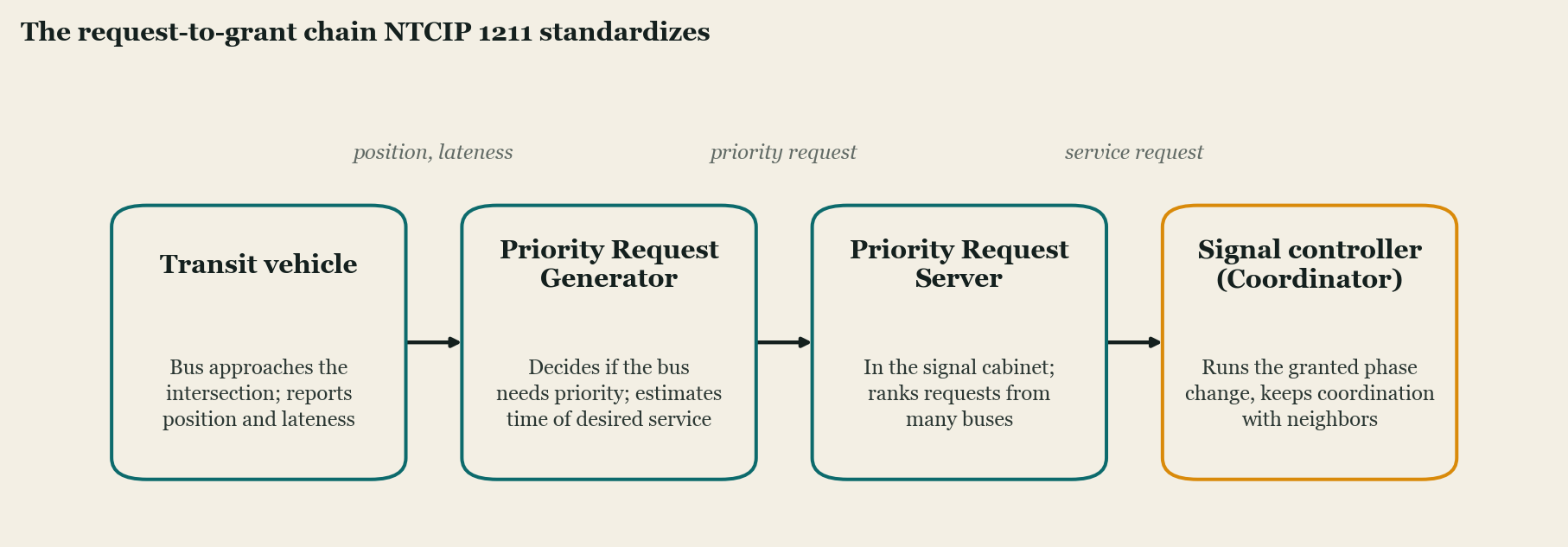
Splitting the work this way matters because the two ends are owned by different organizations. The transit agency installs and runs the generators, usually as equipment on its buses. The traffic agency installs and runs the servers and the controllers in its cabinets. Neither one can dictate the other’s hardware, so the value of a standard is that it lets them agree on the messages without agreeing on the vendor.
What the signal actually does
Granting priority comes down to a handful of moves the controller can make to a running signal plan. Most deployments use one or two of them. The tradeoffs are what a traffic engineer weighs before turning any of them on.
| Strategy | What the signal does | The tradeoff |
|---|---|---|
| Green extension | Holds a green that is already showing for the bus a few extra seconds so it clears on the current phase | Only helps when the light is already green; delays the start of the next phase. The handbook calls it one of the most effective moves because it adds no new clearance time |
| Early green (red truncation) | Shortens the preceding phases to bring the bus’s green back sooner when the light is red on its approach | Takes green away from cross traffic, and is bounded by minimum green, pedestrian walk, and clearance intervals |
| Queue jump | Gives the bus a brief advance green, often from a short right-side lane or shoulder, so it pulls out ahead of the queued cars | Needs the extra lane or shoulder and usually a separate signal head, so it is an infrastructure decision, not just a timing change |
| Phase insertion | Injects a short transit-only green that the cycle would not otherwise run, for example to serve a queue jump or a near-side stop | Adds a whole phase and its clearance time to the cycle, so it costs cross traffic the most |
| Phase rotation | Reorders the phases, such as bringing a lagging left turn ahead, so the bus’s movement is served sooner without adding time | Changing the order can undercut driver expectation and complicate coordination with adjacent signals |
Green extension and early green are the common pair, and the split between them is simply whether the light happens to be green or red when the bus checks in. Extension asks the signal to keep doing what it is doing for a moment longer. Early green asks it to hurry back. Queue jumps and inserted phases do more for the bus but cost more to build and cost cross traffic more to run, so they tend to show up on bus rapid transit corridors where the investment is justified.
Why the standard is the point
Strip out the standard and the whole arrangement falls apart at the seam. A priority request generator from one vendor and a signal controller from another have no shared language: the request has no agreed format, the arbitration between competing requests has no agreed behavior, and the agency is quietly locked into buying both ends from one supplier. NTCIP 1211 is what removes that lock. By defining the generator and the server as standard logical entities, specifying the priority request, update, and cancel messages that pass between them, and carrying those requests in a defined data structure (the standard’s priority request table), it lets an agency buy onboard equipment from one vendor and signal controllers from another and still have them negotiate priority. That is the whole interoperability case for the standard, and it is why TSP belongs to the same standards conversation as the rest of the center-to-field data layer.
The honest caveat is that the seam is not always used. Plenty of deployed TSP still runs on proprietary local detection, such as optical emitters on the bus and matched receivers at the intersection, where the priority request never crosses a vendor boundary and the standard’s message set is beside the point. The FTA handbook found that a large share of TSP systems ran on off-the-shelf signal controllers using the priority software the controller’s own manufacturer supplied. So NTCIP 1211 defines where interoperability can happen. Whether a given corridor actually gets it is a procurement question, decided when the agency writes the specification, not a property the standard delivers on its own.
What to watch
The benefits agencies report are real but they scatter, and they depend heavily on how much signal delay a corridor had to start with. The FTA handbook, drawing on early North American deployments, put typical bus travel-time savings on the order of 15 percent where signal delay was significant, with individual results ranging widely. Portland’s TriMet measured about a 10 percent improvement in travel time and up to a 19 percent reduction in travel-time variability. Chicago’s Pace buses averaged a 15 percent cut in running time on one corridor, varying from 7 to 20 percent by time of day. Los Angeles reported up to a 25 percent reduction on some routes, and Tacoma cut transit signal delay by about 40 percent on two corridors after pairing TSP with signal retiming. Those figures are two decades old and were measured different ways, so treat them as evidence that TSP works when the delay is there to be recovered, not as a rate card.
What has changed since is the precision of the request. Most of those early numbers came from the loop-and-emitter era, when a bus could do little more than announce that it had arrived. Today’s buses carry GPS and automatic vehicle location, which feed schedule-aware conditional priority that can decide, per approach, whether a bus is late enough to be worth the ask. The next step is the connected-vehicle turn playing out across the rest of ITS, where a bus requests priority directly from the intersection over a short-range link rather than through a chain of management centers. When that arrives at scale it will not change the underlying question, only the wire it travels on. The emitters and controllers are the visible hardware, but the intelligence in transit signal priority sits somewhere quieter: in the negotiation itself, a late bus and a signal it has never met agreeing, in the space of a phase, on a few seconds of green. NTCIP 1211 is what lets that conversation happen across vendors. Whether an agency gets the benefit depends less on buying priority-capable buses and signals than on making the two actually talk.
Common questions
- What is transit signal priority?
- Transit signal priority (TSP) lets a bus that is running behind ask a traffic signal to turn green a little sooner or hold green a little longer, just long enough to let it through. The bus does not force the change: it requests, and the signal grants while keeping its own cycle and its coordination with the next intersection intact.
- What is the difference between signal priority and preemption?
- Priority is a negotiated request the signal can grant within its normal cycle, used routinely for late buses. Preemption overrides the cycle outright, as it does for an emergency vehicle. TSP is priority, not preemption.
- What standard governs transit signal priority?
- NTCIP 1211 defines how the request-to-grant exchange works between the bus and the signal. Building to the standard is what lets equipment from different vendors interoperate rather than locking an agency into one supplier.