Explainer · Quality & Compliance
Bus bunching and headway: why three arrive at once
Three buses arriving nose to tail is not bad luck. It is a feedback loop in frequent service, where a late bus falls further behind and the one behind it catches up. Here is the mechanism, why agencies measure headway instead of schedule, and what they do about it.
Bus bunching is what happens when buses that are supposed to be evenly spaced clump together, so a rider watches nothing come for a long stretch and then two or three buses arrive in a row. It is easy to read as bad luck or a slow driver, and it is neither. Bunching is a feedback loop built into the way frequent bus service works, and once it starts it feeds itself. The fix is almost never running buses more precisely to a timetable. It is managing the gap between buses, the headway, directly.
The headway is simply the time between one bus and the next on the same route. A route scheduled every 10 minutes has a 10-minute headway. On frequent routes, that gap, and not the printed timetable, is what riders actually experience. They arrive at the stop without checking a schedule and wait for whatever comes next. If buses come every 10 minutes and people show up at random, the average wait is around 5 minutes, half the headway. Keep the gaps even and the system works as advertised. Let them drift apart and the average wait climbs and gets harder to predict, even if the same number of buses runs the same route.
Why one delay becomes three buses
Now suppose a single bus falls a little behind, for any of the ordinary reasons: a wheelchair boarding, a long red light, a fare dispute, a surge of riders at one stop. That bus arrives at its next stop to find a larger crowd than usual, because more time has passed since the previous bus cleared the same stop. A bigger crowd means a longer dwell, the time the bus sits at the curb while people board, which puts it further behind, which means an even bigger crowd at the stop after that. The delay does not stay constant. It grows.
Meanwhile the bus behind the late one is now arriving at stops that were just served, so it finds fewer people waiting, dwells less, and gains ground. The gap ahead of the late bus stretches while the gap behind it collapses. The two end up running together, and a third can pile on behind them. This is the mechanism the transit-operations literature has described for decades: high demand and longer-than-scheduled dwell times cause headways to become shorter than scheduled and platoons of vehicles to develop, with long intervals in between, and the effect is cumulative. It is why short-headway service is called inherently unstable. On busy lines with short headways, buses cannot easily be held to a schedule and tend to arrive irregularly, in bunches, unless something actively pushes them back apart.
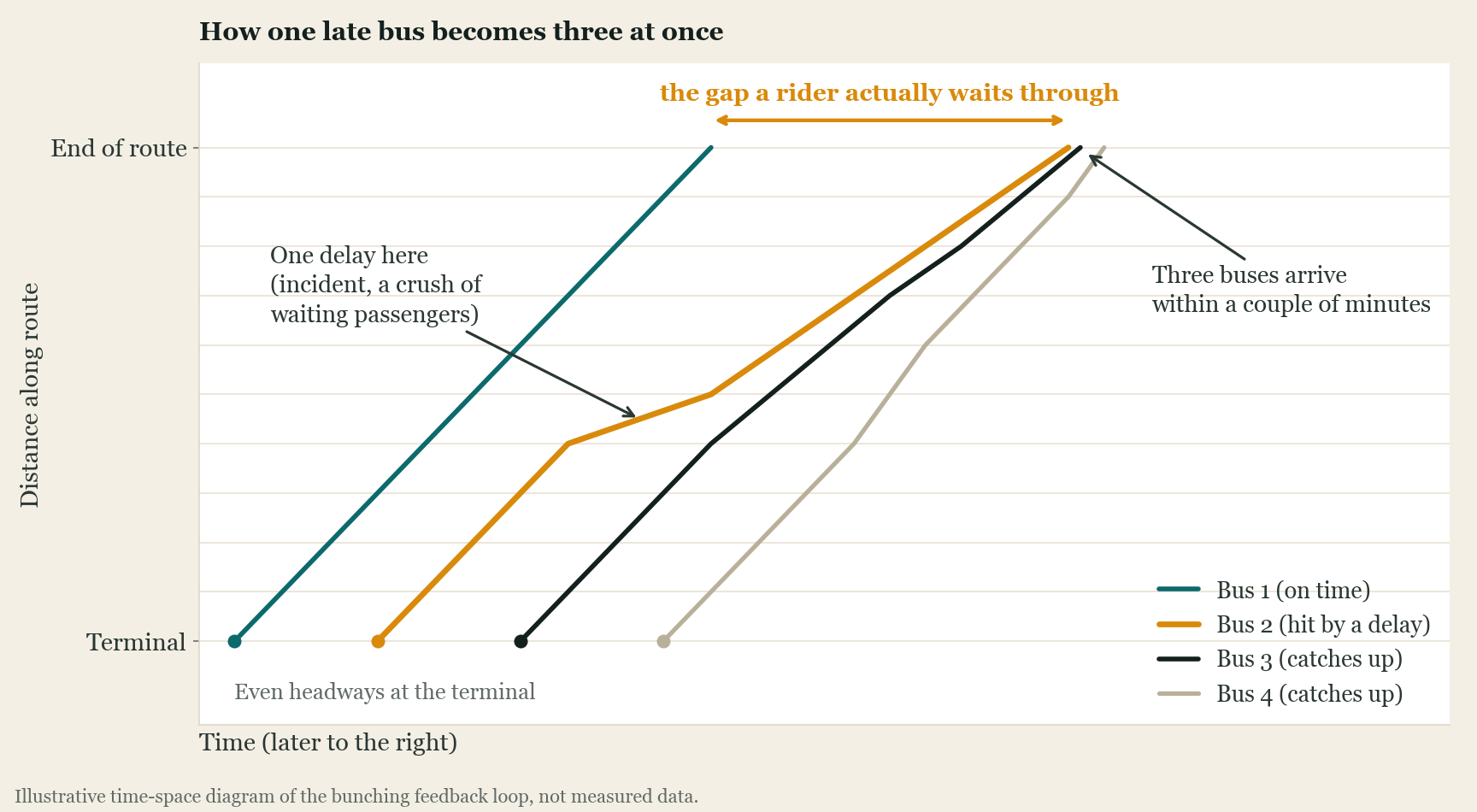
Bunching is expensive in two ways that do not show up if you only count how many buses ran. The late bus is packed, because it is absorbing the riders for a double-length gap, while the buses tucked behind it run nearly empty. So the route loses effective capacity even though every scheduled trip operated. And the riders who drew the long gap wait far longer than the schedule implies, which is the part they remember.
Why frequent service is measured by headway, not schedule
This is the reason agencies that run frequent service track headway adherence rather than on-time performance. On a route that comes every few minutes, whether a particular trip left three minutes after its scheduled time barely matters to anyone. What matters is whether the gaps between buses stayed even. The standard yardstick is the coefficient of variation of headways, the spread of the actual gaps divided by the average gap. A low number means regular service. A high number means bunching. The Transit Capacity and Quality of Service Manual applies this headway-based standard to routes running about every 10 minutes or better, where riders arrive at random, and reserves schedule-based on-time performance for less frequent routes where people plan around a timetable.
For the data and technology layer, that distinction decides which number a reliability dashboard should even be watching. Point an operations team at on-time performance for a route that comes every six minutes and they will optimize the wrong thing. The feeds an agency already runs, the automatic vehicle location (AVL) data behind its GTFS-Realtime, hold everything needed to compute headway adherence continuously. Whether that gets surfaced as a live control signal or only as a monthly report is a systems choice, not a data-availability one.
What operators do about it
There is no single fix, because bunching has two faces: the delays that seed it, and the uneven gaps once it takes hold. The main tools attack one face or the other.
| Strategy | What it does |
|---|---|
| Schedule (timepoint) holding | A bus running early waits at a designated timepoint until its scheduled departure. It keeps buses from leapfrogging the timetable, but it needs slack built into the schedule, which slows the route, and it does little once a bus is already late. |
| Headway-based holding | The control center holds buses to keep the gaps between them even, using real-time positions instead of the clock. It targets the actual failure, uneven headways, and needs less built-in slack than schedule holding, so buses can run faster for the same regularity. |
| Transit signal priority | Roadside equipment detects an approaching bus and extends or brings up a green so the bus spends less time waiting at signals. It trims running time, and when it favors buses that are running late it damps the delays that start the loop. |
| Stop consolidation | Removing or spreading out closely spaced stops leaves fewer places to dwell and fewer chances for a boarding surge to stall a bus. Agencies report it as one of the most effective and cheapest ways to speed buses up, which also removes points where the feedback loop can start. |
The trade is the same across the schedule-based tools: holding a bus to protect the headway means deliberately making that bus slower, and riders already aboard feel the wait. The reason headway-based control has spread is that it buys the same regularity for less of that penalty. Signal priority and stop consolidation work further upstream, on the running-time variability that gives delays a foothold in the first place, which is why the strongest programs pair a control strategy with the roadway treatments rather than choosing between them.
None of this is new engineering. What changed is that continuous vehicle-position data now makes headway-based control practical in the moment, at the dispatcher’s screen, rather than in a report written after the bunch has already carried its riders. The data does not dissolve the feedback loop. It lets an agency see the gaps drifting apart and act while there is still a gap to protect, before one late bus quietly becomes three.
Common questions
- What causes bus bunching?
- A feedback loop. A bus that falls slightly behind picks up the riders who have waited longest, which slows it further, while the bus behind catches emptier stops and speeds up. Left alone the gap grows until buses arrive in a clump. It is built into how frequent service works, not bad luck or a slow driver.
- What is headway?
- The headway is the time between one bus and the next on the same route. A route scheduled every 10 minutes has a 10-minute headway, and on frequent routes that gap, not the printed timetable, is what riders actually experience.
- How do agencies prevent bus bunching?
- By managing headway rather than adherence to a clock: holding a bus briefly at a control point to even out the gaps, and helping late buses recover with tools such as transit signal priority. The fix is almost never simply running more buses.