Explainer · Interoperability
V2X after DSRC: what the December 14 sunset means for roadside units
On December 14, 2026, the FCC ends DSRC in the 5.9 GHz safety band and C-V2X becomes the only vehicle-to-everything radio allowed there. What V2X is, what changes on the roadside and in the vehicle, and what the federal license record shows a month before the cutoff.
On December 14, 2026, dedicated short-range communications (DSRC) stops being a legal way to run vehicle-to-everything radios in the United States. The FCC’s Second Report and Order made cellular vehicle-to-everything (C-V2X) the only technology allowed in the 5.895 to 5.925 GHz safety band, and gave incumbents two years from its December 13, 2024 publication to switch. In an October 5 reminder the two FCC bureaus that license these radios said that after the sunset, “authority to operate DSRC-based roadside units (RSUs) will terminate, and the Bureaus will delete all DSRC-based RSUs” from the licenses they sit on.
In the FCC’s mid-November license files, 75 live licenses in the two ITS radio services together register 10,006 roadside unit locations. About 43 percent of them carry a C-V2X marker in the record, either a registration filed since the new rules took effect in February 2025 or a condition left by the early C-V2X waivers. Another 47 percent sit on the licenses of agencies and research groups that ran C-V2X early under waivers but carry no marker, so the public record does not say which radio is on the pole. The last 10 percent have no C-V2X filing and no waiver.
What V2X is
The FCC’s own short definition, from a January 2025 order, is that V2X technology “allows vehicles to communicate directly with other vehicles (V2V), infrastructure (V2I), and vulnerable road users such as pedestrians and bicyclists (V2P)” over the 5.9 GHz frequencies, “without the participation of a cellular network or other base stations.” The word “cellular” in C-V2X refers to the standards family the radio comes from. The safety messages go device to device, with no phone network carrying them.
In the ITS Joint Program Office’s description, vehicles “exchange frequent, structured messages about relative speed, position and other relevant data” with whatever is nearby, and anything listening can act on them: a car warning its driver about a vehicle about to run a red light, a signal controller holding a green for a late bus, a work-zone beacon telling approaching trucks the right lane is closed. The Joint Program Office treats delivery over an ordinary mobile network as a separate mode, “more suited to carry information over longer distances.” The 5.9 GHz band carries the short-range, low-latency part.
V2X needs two kinds of hardware. A roadside unit (RSU) is a fixed radio mounted at an intersection or along a corridor. An on-board unit (OBU) is the radio in the vehicle. Roadside units are registered one by one with the FCC against a licensee’s geographic license. On-board units are licensed by rule, which means a compliant device in a vehicle needs no license of its own.
How the band got to 30 MHz and one radio
The whole 75 MHz of the 5.9 GHz band used to belong to transportation. In its 2020 First Report and Order the FCC concluded, as the 2024 order summarizes it, that the DSRC services once planned for the band “had not come to fruition in the 20 years since it allocated the spectrum.” It opened the lower 45 MHz (5.850 to 5.895 GHz) to unlicensed use for next-generation Wi-Fi, and kept the upper 30 MHz for transportation, on the condition that it move to C-V2X.
| Date | Step |
|---|---|
| November 2020 | First Report and Order: lower 45 MHz to unlicensed use, upper 30 MHz kept for ITS, C-V2X named as the technology |
| July 5, 2022 | Deadline for ITS licensees to stop transmitting in the lower 45 MHz |
| 2023 to 2024 | Waivers let 28 licensees run C-V2X roadside units before final rules existed |
| November 21, 2024 | Second Report and Order released: C-V2X technical rules and the two-year DSRC sunset |
| February 11, 2025 | C-V2X rules take effect; new licenses authorize C-V2X only; no new DSRC roadside units may be registered |
| October 5, 2026 | FCC bureaus remind licensees of the deadline |
| December 14, 2026 | DSRC authority ends; unconverted DSRC roadside units are deleted from licenses |
The rules leave the upper band as three 10 MHz channels, 5.895 to 5.905, 5.905 to 5.915, and 5.915 to 5.925 GHz, which a licensee may combine into 20 MHz or use as one 30 MHz channel “without restriction.” Roadside units are held to a radiated power density limit of 33 dBm per 10, 20, or 30 MHz channel. The order keeps the old antenna height rule: above 8 meters (about 26 feet) over the roadway the unit has to cut its power, and 15 meters (about 49 feet) is the ceiling. Roadside units inside the coordination zones around federal radar sites still have to be cleared with NTIA first.
The FCC also declined to write any particular 3GPP release into its rules. The record split between Release 14, the LTE-based version that the SAE profiles build on, and Release 16, which adds 5G capabilities. The Commission left the choice of standard to industry and set only the power and emissions limits any device has to meet.
What changes, and what stays the same
DSRC units transmit with IEEE 802.11p, a Wi-Fi variant for vehicles. C-V2X units transmit with the LTE-V2X direct link that 3GPP calls PC5 sidelink, in its mode 4, where devices pick their own transmission slots with no base station involved. The two do not talk to each other. The FCC cited “the lack of interoperability between DSRC and C-V2X operations” as a reason to stop licensing new DSRC units the day the rules took effect, and declined a proposal to keep one 10 MHz channel for DSRC during the transition. A converted intersection and an unconverted bus therefore cannot exchange anything.
Most of what rides on the radio stays the same. SAE J2735, the message set that ARC-IT still catalogs under its old name, “DSRC Message Set,” defines the basic safety message vehicles broadcast and the signal phase and timing, map, and signal request messages that intersections and buses exchange. The SAE standard for C-V2X vehicle safety radios, J3161/1, carries that same J2735 basic safety message over the PC5 sidelink and keeps the IEEE 1609 standards for the network, transport, and security layers. ARC-IT lists LTE-V2X profiles for the J2735 signal control and signal preemption messages, traveler information, weather, and vulnerable road user messages. Application logic built on J2735, and the security credential system that signs the messages, should carry over. The radio hardware, its firmware, and its certification do not.
For a traffic engineer the practical result is that a corridor’s applications can survive the switch while every box at the roadside and every unit in the fleet is replaced or reflashed. The FCC said plainly it would not pay for that: “the Commission will not take action on reimbursement at this time.” C-V2X devices certified under the old waivers can keep operating and being sold, as long as they are not modified.
What the license record shows
The FCC’s weekly license files from November 14 and 15, 2026, list 75 active ITS licenses holding 10,006 registered roadside unit locations. A registered location is permission on file; it does not mean a radio is working there today.
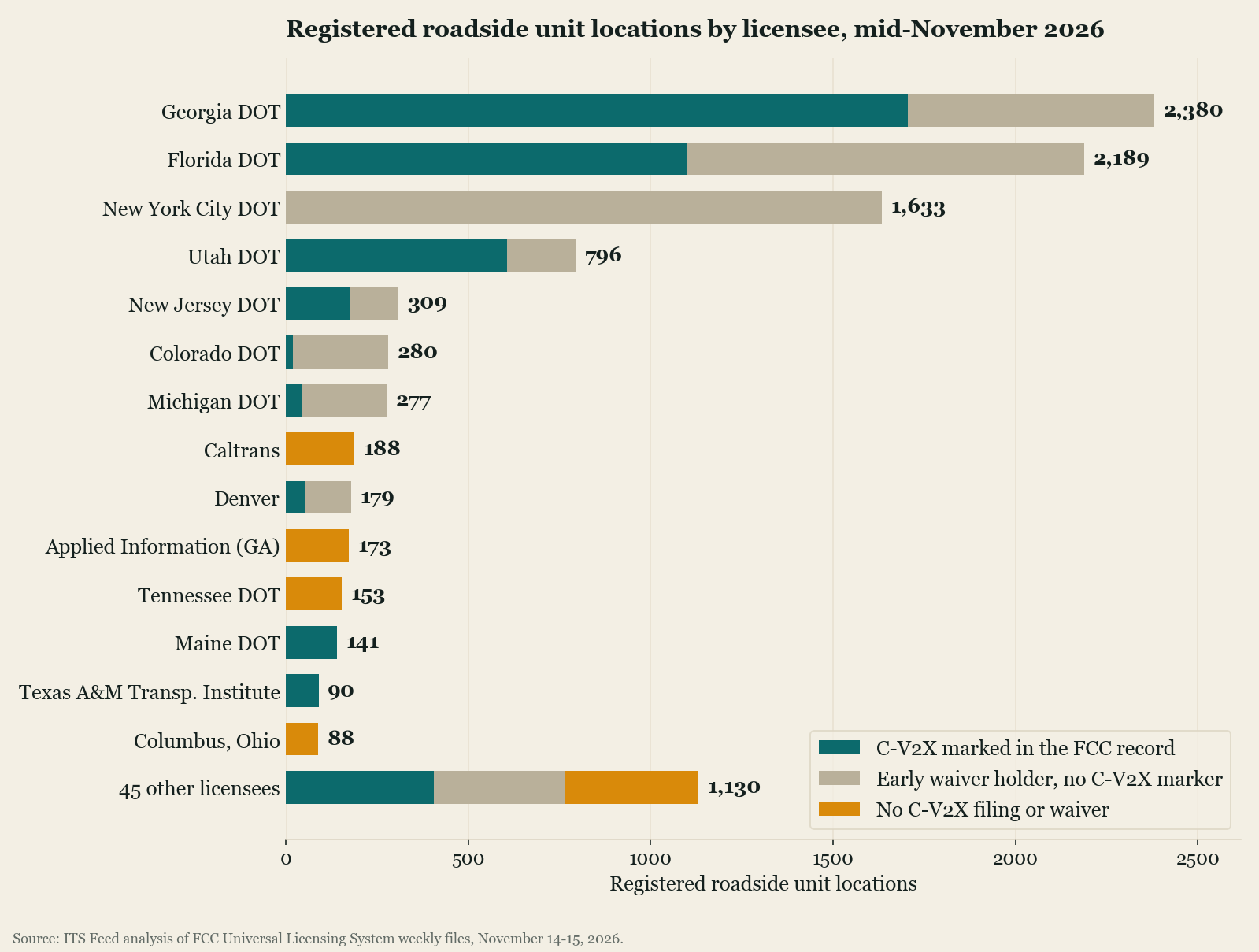
Georgia DOT, Florida DOT, New York City DOT, and Utah DOT hold 70 percent of those locations.
The record marks C-V2X in two ways. Since February 2025 the filing instructions have required a “C-V2X RSU Registration” attachment to convert a DSRC unit or add a new C-V2X one, and the early waiver grants left a C-V2X condition on many individual locations. By those markers, 4,342 locations, 43 percent, are C-V2X on the record. Most of the post-2025 filings added new units rather than converted old ones: 2,166 new against 819 conversions, 735 of the conversions in Georgia.
Another 4,698 locations, 47 percent, sit on the licenses of the 28 early waiver holders with neither marker. The bureaus told those licensees they “need take no further actions” to keep C-V2X units they had already registered, so a location here may be C-V2X running since 2023 or a DSRC unit nobody has converted, and the public data files do not say which. All 1,633 of New York City’s locations, the largest deployment held by a single city, are in this group.
The last 966 locations, on 24 licenses, have no C-V2X filing and no waiver behind them. On the FCC’s own terms these are DSRC registrations, the ones the bureaus have said they will delete after December 14 unless converted. Caltrans (188 locations), Applied Information (173), Tennessee DOT (153), and the City of Columbus (88) hold the most, and none of the four has filed a C-V2X registration since the rules took effect. The filings are not a perfect record of the street, so a licensee in this group may have switched without filing the attachment the bureaus asked for.
Of the 75 live licenses, 15 were first issued after the C-V2X rules took effect, including MassDOT, Hawaii DOT, Maryland’s State Highway Administration, the Texas A&M Transportation Institute, the cities of Fremont, Anaheim, Seattle, and Franklin, Tennessee, and, on October 29, 2026, the New York City Transit Authority. That license registers no roadside units yet.
Why transit agencies are in this
Transit signal priority is one application that puts V2X radios on buses. A bus that asks a signal for a few more seconds of green over V2X sends a J2735 signal request over the same 5.9 GHz link, and after December 14 that link has to be C-V2X at both ends. An agency whose buses carry DSRC units has to replace them in step with the city or state DOT that owns the signals.
Transit is also in scope at the federally funded C-V2X sites. In fall 2024 the US DOT awarded $60 million in V2X Accelerator agreements to Maricopa County, the Texas A&M Transportation Institute, and Utah DOT. Utah’s share plans 770 roadside units in Utah and Colorado and 220 on-board units in fleet vehicles, snowplows, transit buses, and emergency vehicles, with the Utah Transit Authority as a partner. All three accelerator licensees have C-V2X registrations on file.
What an agency should check before December 14
The first check is the license. Every roadside unit an agency depends on should appear on its ITS license (radio service IQ for public safety licensees, QQ for others), and any unit that is still DSRC needs either a Schedule M modification with the C-V2X RSU Registration attachment or a plan to switch it off. The bureaus’ instructions say to select the whole upper 30 MHz and de-select any lower 45 MHz channels still shown. The licensing system still displays the old DSRC channel numbers, and the October notice says it will be updated “at a later date.”
The second is the fleet. On-board units need no license, but a DSRC unit on a bus becomes useless once the intersections around it convert, and the FCC has said it will allow “flexibility in ceasing DSRC OBU operations” rather than force a cutoff on vehicles. Utah DOT told the FCC its DSRC on-board units would all be replaced with C-V2X units before the deadline, with the work done at night to keep disruption down.
The third is the procurement language. Because the FCC did not adopt a 3GPP release, a specification that only says “C-V2X” leaves the release, the SAE profile, and the certification open. Naming J3161/1 for the radio, the J2735 messages the corridor actually uses, and the security credential management system the devices enroll in narrows that gap.
What to watch
The first weekly license files after December 14 should show how many DSRC locations the bureaus deleted, which will be the first public count of registrations that did not make the switch. We will re-run this count then. The open item after that is the licensing system itself, which still describes the band in DSRC channels, and the rules, which leave the step from LTE-V2X to 5G-based sidelink to industry. For the wider picture of where V2X sits in the transportation technology stack, see what intelligent transportation systems are.
Common questions
- What is V2X?
- Vehicle-to-everything (V2X) is direct radio communication between vehicles (V2V), between vehicles and roadside infrastructure such as traffic signals (V2I), and between vehicles and pedestrians or cyclists (V2P), without a cellular network or base station in the path. In the United States it runs in the upper 30 MHz of the 5.9 GHz band, 5.895 to 5.925 GHz.
- When does DSRC end?
- DSRC operations in the 5.895 to 5.925 GHz band end on December 14, 2026. After that date the authority to operate DSRC roadside units terminates, and the FCC's bureaus will delete any DSRC roadside unit that has not been converted to C-V2X from the license it sits on.
- What is the difference between DSRC and C-V2X?
- They are different radios. DSRC used IEEE 802.11p, a Wi-Fi variant. C-V2X uses the 3GPP LTE-V2X direct link, called PC5 sidelink. The messages carried over the air, such as the SAE J2735 basic safety message and the signal messages, stay the same. The two radios do not interoperate, so a DSRC unit cannot hear a C-V2X unit.
- How does an agency convert a roadside unit from DSRC to C-V2X?
- The licensee files FCC Form 601 Schedule M in the Universal Licensing System to modify the existing roadside unit, attaches a document of the type C-V2X RSU Registration, and selects the whole upper 30 MHz. New C-V2X roadside units are registered the same way. There is no federal reimbursement for the equipment.