Explainer · Feeds & Standards
California's transit stop registry: what AB 1599 asks of your stop data
AB 1599 gives every transit stop in California a state identifier by June 2027 and makes operators publish it by 2028. What the law requires, what Caltrans has not decided yet, and what the shared-stop problem looks like in the data.
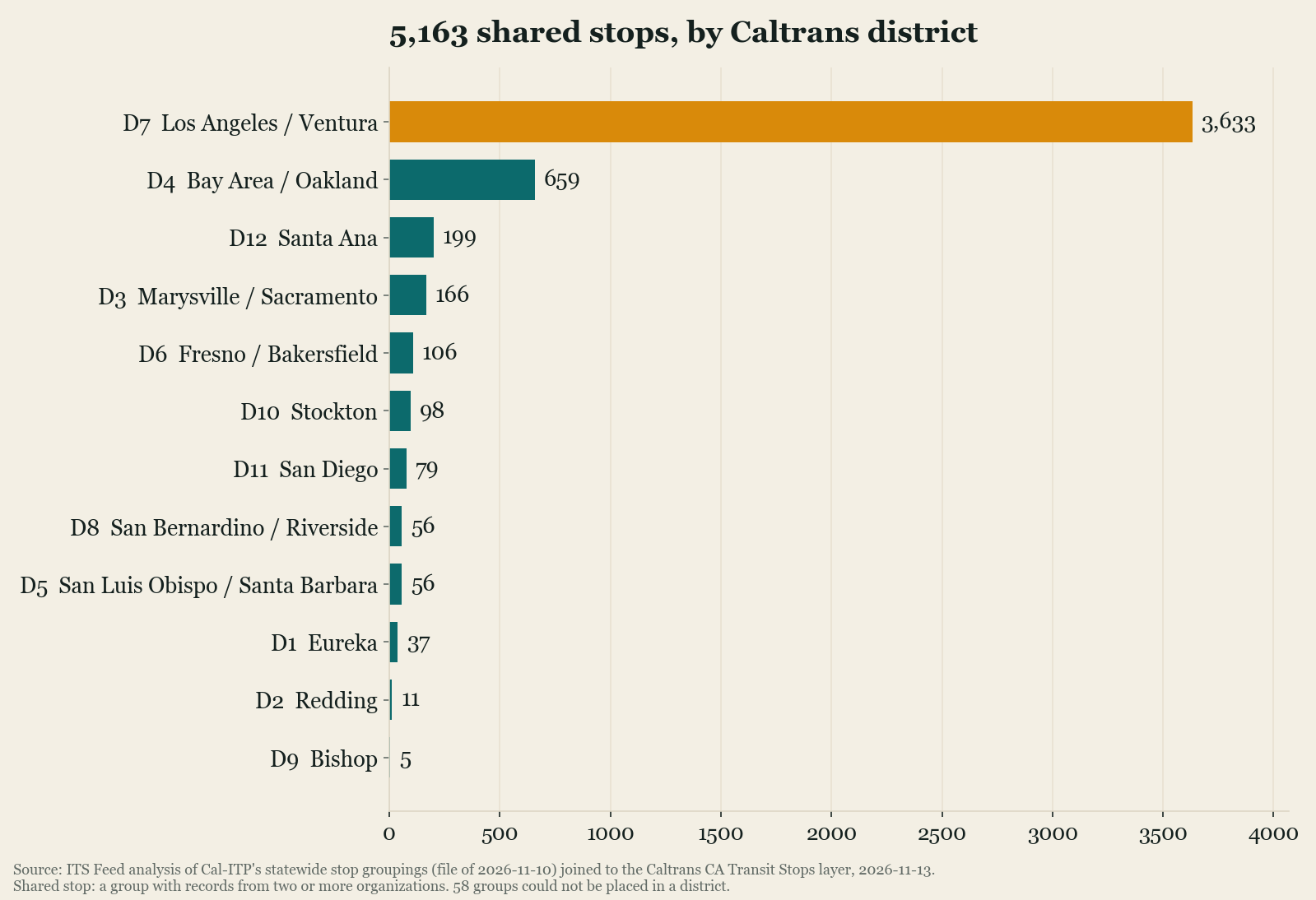
California’s AB 1599 gives every transit stop in the state a single identifier issued by Caltrans. The state has to publish the registry that holds those identifiers by June 1, 2027. By January 1, 2028, every transit operator, as the Transportation Development Act defines one, has to carry the identifier in the stop data it publishes, match its stop names and locations to the registry, and report whether each stop has a seat and a shelter. The law exists because neighboring agencies describe the same curb in different ways. Counting from Cal-ITP’s first automated grouping of the state’s stop data, we find 5,163 physical stops where two or more agencies each keep their own record, and at 270 of them the names match.
The governor signed the bill on September 18, 2026, as Chapter 269 of the Statutes of 2026.
What the law requires, and of whom
| Who | What | Deadline | Statute |
|---|---|---|---|
| Caltrans | Create the registry, with input from transit operators | June 1, 2027 | Gov. Code 14113(a) |
| Caltrans | For each stop: name, location, seating (yes or no), shelter (yes or no), a unique identifier Caltrans establishes | June 1, 2027 | Gov. Code 14113(b) |
| Caltrans | Update at least once a year; build from publicly available data where possible | ongoing | Gov. Code 14113(a) |
| Operators | Make each stop’s name and location conform to the registry | January 1, 2028 | PUC 99150.5(b)(1) |
| Operators | Use the registry identifier when publishing any dataset with stop information | January 1, 2028 | PUC 99150.5(b)(2) |
| Operators | Report seating and shelter for each stop, keyed by the registry identifier | January 1, 2028 | PUC 99150.5(b)(3) |
“Operator” means the definition in Public Utilities Code 99210, the one the Transportation Development Act uses: a city, county, or public district running a public transportation system, among others. Not everyone who publishes California stop data is a TDA operator: the stop file analyzed below also carries university and airport shuttles and intercity carriers.
The dataset clause is wide. The identifier has to appear in “any dataset with stop information,” and the statute lists General Transit Feed Specification datasets, seating and shelter data, stop-level ridership, any format used to feed a trip-planning app, and agency open data.
The law protects operators in two ways. Caltrans “shall not require a transit operator to change
the unique identifying number the operator assigns to each transit stop,” so nobody renumbers
their stop_id values or the codes on their pole signs. And Caltrans has to consider operator
input on the registry’s design, data sources, and collection methods in order to “limit adverse
financial and human resources impacts.” Senate floor amendments in August added that
operator-input language and narrowed what had been a general “amenities” field down to two
yes-or-no facts, seating and shelter.
On money, the Senate floor analysis says Caltrans can absorb the work of building the first datasets through June 30, 2027 under its existing Cal-ITP funding, and puts ongoing costs in the low hundreds of thousands of dollars a year from fiscal 2027-28. For operators the same analysis says only that local costs are “unknown, potentially significant.”
What Caltrans has not decided
Caltrans’s Division of Data and Digital Services, which already collects operators’ GTFS statewide for Cal-ITP, is building the registry. Its draft implementation plan, written in October 2026 for stakeholder review, says nothing in it is final except the statute. What follows is where it stood in mid-November.
The identifier itself is open. The plan sets out three questions in order: whether an ID stays fixed for the life of a stop or is derived from its position and changes when the position is corrected; what it looks like (a county-prefixed code, opaque digits, or a namespaced sequence in the style of Norway’s national stop register, which Caltrans has looked at as a model); and who issues new ones. It makes no recommendation and targets a decision in November or December 2026, after hearing from a small focus group of agencies.
The law names GTFS but gives no field name, file, or schema, so where the ID goes in a dataset
is undecided too. The plan’s lean for the January 2028 deadline is one extra column in
stops.txt, with stop_ca_universal_id as a working name it marks as undecided. A formal
proposal to the GTFS community would come later, since spec consensus “takes years.” Whatever
the column is called, it sits next to the agency’s own stop_id and stop_code and never
replaces them, and Caltrans would publish a crosswalk from each agency’s stop_id to the state
ID.
The draft schedule has a baseline snapshot pinned in November 2026, human review of shared stops through March 2027, a registry freeze in April, and publication in May, a month inside the statutory deadline. Caltrans wants agencies to send corrected positions for shared stops, along with seating and shelter data, by March 1, 2027.
The shared-stop problem, in the data
A stop served by one agency gets an ID and nothing else changes. The hard cases are corners where two or more agencies each publish a record for one physical stop, which a trip planner can read as two places. Cal-ITP has made a first pass at finding them and published the result: California’s GTFS bus stop records (stops served only by rail are left out), grouped by proximity and travel direction into what it judges to be physical stops, with a flag for groups that more than one agency publishes. The grouping is automated and nobody has reviewed it yet, and Cal-ITP’s own estimate of shared stops runs from 3,000 to 6,000 depending on the matching method. Our counts use the November 10, 2026 release.
It holds 91,809 stop records in 81,222 groups. After merging a handful of feed labels that are the same organization publishing twice, 5,163 groups contain records from two or more organizations, about 6 percent of all stop groups, from 184 publishers. Leaving out Amtrak, the state-supported intercity rail authorities, ACE commuter rail, and FlixBus and Greyhound, whose stops overlap local ones at stations, still leaves 5,074. Most shared stops have two publishers; 405 have three, 63 have four, and 24 have five or more.
At only 270 of the 5,163 groups do the publishers use the same name, ignoring capitalization. Most of the rest differ in format: “Spring / 6th” against “Spring St & 6th St,” or a direction tag such as “(Northbound)” on one side only. Some name a different cross street or a landmark. In La Puente, two records about a foot apart are “Puente Ave & Amar Rd” for Los Angeles County and “Puente Ave & Sunkist Dr” for the city. In Mammoth Lakes, Eastern Sierra Transit’s “Old Mammoth Rd / Tavern Rd” is YARTS’s “Mammoth Lakes Park & Ride.”
Measuring the farthest pair of records from different organizations in each group, the median gap is 25 feet, a quarter of groups are more than 42 feet apart, and 965 groups are more than 50 feet apart. These are gaps among the stops the method catches. It links records no more than about 92 feet apart, so a stop placed far from its partners does not appear here at all, and the plan names one such case in Artesia.
The Assembly’s analysis of the bill used Banning as its example: one stop, four agencies, four names. We found no four-agency stop inside Banning in the file. The closest match is in neighboring Beaumont, at the Walmart on East 2nd Street, where Banning’s buses stop alongside three other agencies.
| Agency | stop_id | Name in its GTFS |
|---|---|---|
| City of Banning | 11583 | Walmart (1540 E 2nd St) |
| City of Beaumont | 11677 | Walmart |
| Riverside Transit Agency | 1829 | 2nd St. 1540 at Walmart |
| SunLine Transit Agency | 11130190 | 2nd at Commerce |
All four points fall within 27 feet of each other.
Most shared stops are far from Banning. Caltrans District 7, Los Angeles and Ventura counties, holds 3,633 of them, 70 percent. LA Metro appears in 2,870 shared groups and LADOT in 1,257, with Foothill Transit, Long Beach Transit, Torrance, and Santa Monica’s Big Blue Bus each in more than 240.
Names and positions: what “conform” will mean
The draft plan reads the conformance duty lightly. The registry seeds each stop’s name from the operating agency, so a single-agency stop conforms automatically. Where several agencies share a stop, Caltrans picks one name and suggests it to the others. For position, it picks the best existing agency point, never an average, has a person confirm every multi-agency stop over aerial imagery, and asks each agency to move its coordinates to match.
The plan also says Caltrans will suggest name alignment rather than force it through January 2028, the same date by which the statute requires names to conform. The Assembly’s description of the Banning fix assumed agencies would “continue to call the stop by their unique names” while sharing one ID. The plan does not yet say which reading applies to a stop like the Beaumont Walmart, where four agencies use four names.
Seating and shelter: no GTFS field yet
GTFS has no field for a bench or a shelter; stops.txt carries
location and wheelchair access only. The law requires seating and shelter in the registry by
June 2027, but the operator reporting that fills those fields is not due until 2028. The draft
plan bridges the gap by seeding the first version from whatever is public, with “unknown” as an
accepted value.
At a November 4 meeting with Caltrans, LA Metro staff said Metro has more than 12,000 stops, tracked in spreadsheets by a stops and zones department rather than in its HASTUS scheduling system. The cities own the benches and shelters, so Metro has to ask each city for the inventory, and some cities may not keep one. Metro’s staff also suggested a separate amenities file would be easier than new columns in existing GTFS files.
A proposal to the GTFS community, made in
February 2026 by Cal-ITP, LA Metro, the MBTA, and Transit among others, would add such a file,
an optional stop_amenities.txt: one row per stop and amenity type, with seating and
shelter among the types and a status that can say present, absent, nearby but not part of the
stop, or unknown. It has not been adopted; until something is, the draft plan falls back on
fields Caltrans specifies itself.
What a data lead can do now
Look up your agency in the Cal-ITP groupings file. Filter to your feed, take the groups where another organization appears, and read their names and coordinates next to yours. Those rows are the stops Caltrans will ask you about. For the larger Los Angeles County operators that is hundreds of rows; for most rural operators it is a handful or none.
Find out who edits your GTFS. For many agencies it is a vendor or a scheduling export, which is
why the plan recruits its focus group by software stack: by its count, more than 60 California
services build GTFS in one tool, Trillium. If your stack can carry one extra column in
stops.txt, the likely mechanism is covered. The canonical validator reports an unrecognized
column as an INFO notice, not an error or a
warning, so the column itself will not fail a feed.
List every other place stop data leaves the building: stop-level ridership extracts, open data portal layers, anything sent to a trip planner. The statute names all of them, and the plan expects Caltrans to define the column for non-GTFS data as well.
Start the seating and shelter inventory now, and settle who owns it. If cities own your
shelters, that conversation will probably take longer than the data entry. Some of it may
already be mapped: OpenStreetMap records a shelter
tag on 44 percent of the world’s bus stops, though matching those nodes to your stop_id values
is its own job.
What to watch
The identifier decision, targeted for November or December 2026, settles the format that may end up on pole signs and what happens to an ID when Caltrans corrects a stop’s position. The column name and the crosswalk follow from it. The plan says each decision will be logged publicly as it is made, and Caltrans’s outreach to agencies runs through the winter.
Neither Caltrans’s existing compiled stops layer nor the public GTFS feeds agencies keep for National Transit Database reporting gives a stop an identity beyond the agency that published it. The registry changes what riders see only once trip planners read the new ID.
Common questions
- What is the California Transit Stop Registry?
- A statewide dataset that Caltrans must create by June 1, 2027 under AB 1599 (Chapter 269, Statutes of 2026). For every transit stop in the state it holds the stop's name, its location, whether it has seating, whether it is sheltered, and a unique identifier that Caltrans assigns. Caltrans has to update it at least once a year and build it from publicly available data where it can.
- What does AB 1599 require transit agencies to do?
- By January 1, 2028, every operator as defined in Public Utilities Code 99210, the Transportation Development Act definition, must make its stop names and locations match the registry, use the registry's identifier whenever it publishes a dataset with stop information (GTFS, stop-level ridership, seating and shelter data, trip-planner formats, and open data), and report whether each stop has seating and shelter.
- Do agencies have to change their GTFS stop_id values?
- No. The statute says Caltrans may not require an operator to change the identifying number it assigns to its stops. Caltrans's draft implementation plan treats the registry identifier as an extra field carried alongside the agency's own stop_id and stop_code, with a published crosswalk from one to the other.
- Where does the registry identifier go in a GTFS feed?
- That is not decided. The law names GTFS but sets no field name or format. The draft plan from October 2026 leans toward one extra column in stops.txt for the January 2028 deadline, with a formal GTFS proposal pursued later, and lists the field name and the identifier format as open decisions.